Biography
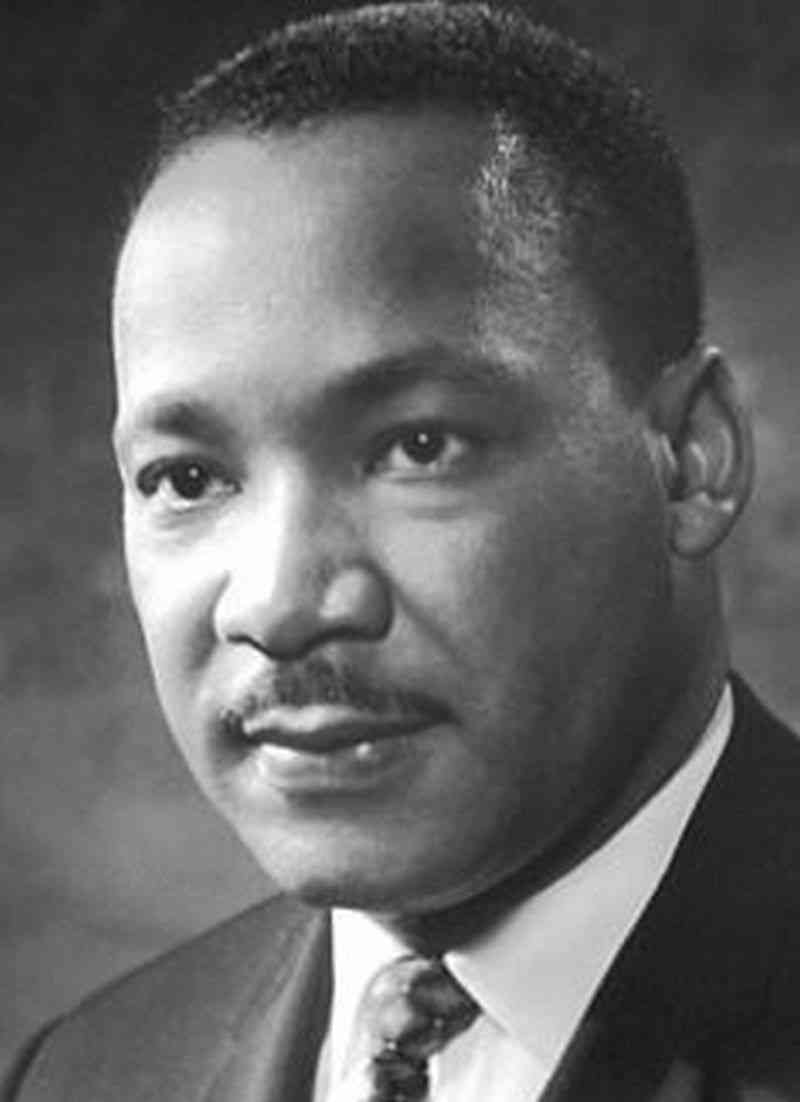
Martin Luther King, Jr. was a pivotal figure in the American civil rights movement during the 1950s and 1960s. Born on January 15, 1929, in Atlanta, Georgia, he was the son of Martin Luther King Sr., a Baptist minister, and Alberta Williams King. King grew up in a supportive and religious household, where the values of equality and justice were instilled in him from an early age.
King's journey as a civil rights leader began during the Montgomery Bus Boycott in 1955. This protest was sparked by the arrest of Rosa Parks, an African American woman who refused to give up her seat to a white person on a segregated bus. The boycott, which lasted for 381 days, marked the first large-scale demonstration against segregation in the United States. King emerged as a leader during this time, advocating for nonviolent resistance inspired by Mahatma Gandhi's philosophy.
In 1957, King, along with other civil rights leaders, founded the Southern Christian Leadership Conference (SCLC) to
 Birth — 1929
15 January 1929
Atlanta, Georgia, USA

1934 - The metal beverage can is invented (American Can Co., United States)
1940 - April - 1st electron microscope demonstrated (RCA), Philadelphia, Pennsylvania, USA
 1944 - D-Day, which occurred on June 6, 1944, was a pivotal World War II operation where Allied forces launched a massive invasion on the beaches of Normandy, France. Known as Operation Overlord, it involved over 156,000 troops from the United States, United Kingdom, Canada, and other Allied nations. The operation aimed to liberate Western Europe from Nazi German control. The landings marked the beginning of the end for Nazi Germany, leading to the eventual Allied victory in Europe.
 The microwave oven was invented accidentally in 1945 by Percy Spencer, a Raytheon engineer. While testing a magnetron, he noticed microwaves melted a candy bar in his pocket. Experimenting further, he discovered microwaves could cook food quickly. Raytheon patented the process, and by 1947, they built the first commercial microwave oven, called the 'Radarange.' Initially used in commercial settings, microwaves becomes affordable for home use by the 1960s and 1970s, revolutionizing cooking.
 1953 Marriage / Partner
Martin Luther, Jr. KING and Coretta SCOTT 18 June 1953, Heiberger, Perry, Alabama, USA
He was 24 years old.
Martin Luther King, Jr. led the 1955 Montgomery bus boycott
The Montgomery bus boycott of 1955-1956 was a pivotal event in the civil rights movement in the United States. It was sparked by the arrest of Rosa Parks, an African American woman who refused to give up her seat to a white person on a bus in Montgomery, Alabama, on December 1, 1955. Her arrest led to a boycott of the city's bus system by African Americans, who made up the majority of the bus ridership. The boycott was organized by the Montgomery Improvement Association (MIA), a group led by Martin Luther King, Jr., who was a young minister at the time.
The boycott lasted for 381 days, during which African Americans organized carpools and other means of transportation to avoid using the buses. The boycott was a significant challenge to the segregation laws of the time and drew national attention to the civil rights movement. It also marked the rise of Martin Luther King, Jr., as a prominent leader in the movement. The boycott ended on December 20, 1956, after the Supreme Court
1955 Birth of ChildYolanda Denise KING was born 17 November 1955, Montgomery, Alabama, USA
Martin Luther, Jr. was 26 years old.
Martin Luther King, Jr. helped found the Southern Christian Leadership Conference (SCLC) in 1957, serving as its first president.
In 1957, Martin Luther King, Jr. played a pivotal role in the founding of the Southern Christian Leadership Conference (SCLC), an organization that would become a major force in the American civil rights movement. The SCLC was created in response to the successful Montgomery Bus Boycott, a protest against segregated seating on city buses in Alabama. King, along with other civil rights leaders, sought to harness the momentum of the boycott and other protests to create a unified, nonviolent movement for racial equality.
As the first president of the SCLC, King helped to organize and lead numerous campaigns and demonstrations across the South. The SCLC's philosophy was rooted in nonviolent resistance, inspired by the teachings of Mahatma Gandhi. Through his work with the SCLC, King became a national figure and a leading voice in the fight against segregation and racial discrimination in the United States. The organization's efforts would eventually lead to the passage of the Civil
1961 Birth of ChildDexter Scott KING was born 30 January 1961, Atlanta, Georgia, USA
Martin Luther, Jr. was 32 years old.
With the SCLC, King led an unsuccessful 1962 struggle against segregation in Albany, Georgia.
In 1962, Martin Luther King Jr., alongside the Southern Christian Leadership Conference (SCLC), led a significant but ultimately unsuccessful campaign against segregation in Albany, Georgia. The Albany Movement was a pivotal moment in the civil rights movement, marking a shift in strategy for King and his colleagues. The campaign aimed to challenge segregation laws through nonviolent protests and civil disobedience, drawing national attention to the injustices faced by African Americans in the South.
Despite King's efforts to mobilize the local community and apply pressure on city officials through peaceful demonstrations, Albany's leaders remained steadfast in their commitment to segregation. The movement faced several challenges, including a strong police response, the reluctance of local white business owners to negotiate, and divisions within the African American community over the best approach to achieving their goals.
1962 - The Cuban Missile Crisis was a tense 13-day standoff in October 1962 between the United States and the Soviet Union over the installation of Soviet nuclear missiles in Cuba, just 90 miles from the U.S. coast. The crisis is considered the closest the Cold War came to escalating into a full-scale nuclear war. It began when American spy planes discovered the missiles, leading to a U.S. naval blockade of Cuba and intense negotiations. The crisis ended when Soviet Premier Nikita Khrushchev agreed to remove the missiles in exchange for the U.S. promising not to invade Cuba and secretly agreeing to remove American missiles from Turkey.
April 1963 - Martin Luther King, Jr. helped organize the nonviolent protests in Birmingham, Alabama.
In April 1963, Martin Luther King, Jr., along with other civil rights leaders, organized a series of nonviolent protests in Birmingham, Alabama. The protests were a part of the larger civil rights movement aimed at ending racial segregation and discrimination against African Americans. Birmingham was chosen as a target for protest due to its reputation as one of the most segregated cities in the United States at the time.
The protests, which included sit-ins, marches, and boycotts, were met with violent opposition from local authorities and white supremacists. Images of police dogs and fire hoses being used against peaceful protesters shocked the nation and drew attention to the brutality of segregation. Despite the violence, King and the protesters remained committed to nonviolence, which ultimately helped to garner national support for the civil rights movement and led to the desegregation of Birmingham's public facilities. The events in Birmingham were a turning point in the
1963 - I Have a Dream Speech - Martin Luther King's Address at March on Washington August 28, 1963.
On August 28, 1963, during the March on Washington for Jobs and Freedom, Martin Luther King Jr. delivered his iconic 'I Have a Dream' speech at the Lincoln Memorial in Washington D.C. The speech is renowned for its powerful rhetoric and calls for an end to racism and for civil and economic rights. King spoke passionately about his dream of a future where all people would be judged by their character and not by the color of their skin, echoing the ideals of equality and justice for all.
The speech was a pivotal moment in the Civil Rights Movement, galvanizing supporters and drawing attention to the ongoing struggle for racial equality in the United States. It is considered one of the most important speeches in American history and helped to spur the passage of the Civil Rights Act of 1964. King's words continue to resonate today, inspiring people around the world to strive for a more just and inclusive society.
1963 - I Have a Dream Speech - Martin Luther King's Address at March on Washington August 28, 1963.
1964 - Awarded Nobel Peace Prize
On October 14, 1964, Martin Luther King Jr. was awarded the Nobel Peace Prize for his leadership in the American civil rights movement. King's approach to combating racial inequality through nonviolent resistance was a defining aspect of his activism, inspired by Mahatma Gandhi's teachings. His methods included peaceful protests, marches, and civil disobedience, all aimed at achieving civil rights and equality for African Americans in the United States.
The Nobel Committee recognized King's efforts as a significant contribution to the advancement of human rights and peace, highlighting his role in challenging racial segregation and discrimination. King's acceptance speech emphasized the importance of nonviolent resistance in the face of oppression and the need for a global effort to achieve justice and equality for all people.
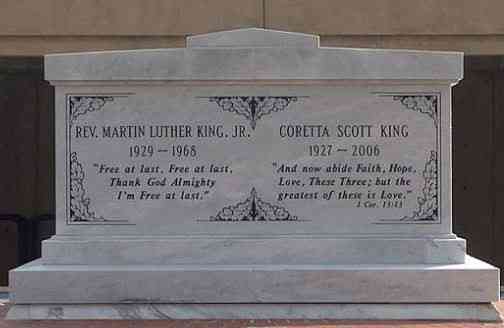

Grave
Martin Luther King, Jr. Center Atlanta Fulton County Georgia, USA
findagrave.com Death — 1968
4 April 1968
Memphis, Tennessee, USA
He died at the age of 39.
1977 - Awarded the Presidential Medal of Freedom (posthumous)
In 1977, Martin Luther King Jr. was posthumously awarded the Presidential Medal of Freedom, the United States' highest civilian honor, by President Jimmy Carter. This award was a recognition of King's immense contributions to civil rights and social justice in America. King's leadership during the civil rights movement of the 1950s and 1960s, his advocacy for nonviolent resistance, and his powerful speeches, such as the iconic 'I Have a Dream' speech, made him a central figure in American history.
2004 - Awarded Congressional Gold Medal (posthumous)
In 2004, Martin Luther King, Jr. was posthumously awarded the Congressional Gold Medal, one of the highest civilian honors in the United States. This award recognized his immense contributions to civil rights and his pivotal role in the advancement of equality and justice for African Americans. King's leadership during the Civil Rights Movement of the 1950s and 1960s was marked by his advocacy of nonviolent resistance against racial segregation, discrimination, and oppression.


 Coretta SCOTT




Questions, Corrections & New Information
Ask a question or share a correction, source, or new detail about Martin Luther, Jr. KING.
When possible, include names, dates, places, and sources so the information is easier to verify.