
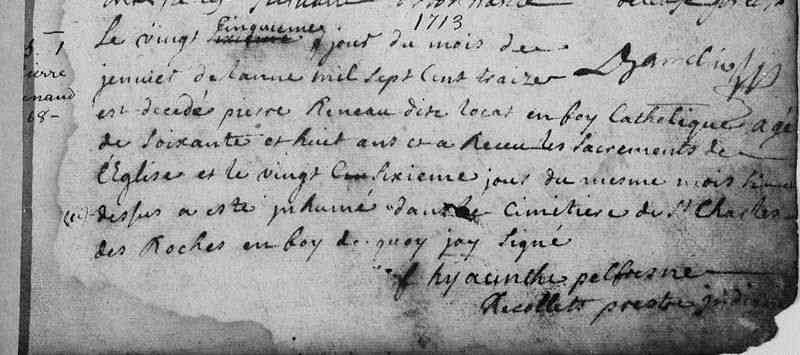
Came to Canada as a soldier of the Carignan-Sallieres regiment 1665 Aug 17.
www.eogen.com/ CarignanSoldiers
He was the son of Jean Renaud-Blanchard and Marie Marguerite Laurence of Corquot, Beziers, Herault, France.
NOTE: According to freepages.genealogy.rootsweb.ancestry.com/ ~villandra/
lucillea/ a9.html#i329
"Leucate is a Mediterranean sea port about halfway between Narbonne and Perpignan. All sources say he was born there, and that is the source of his dit name."
"Pierre-André Renaud took the name Locat by distortion (bad pronunciation) of the name of the locality he was originated, Leucate, a Mediterranean sea port about halfway between Narbonne and Perpignan. The form of the name: Renaud _dit_ Locat is equivalent to Renaud _said_ (AKA) Locat. The name Leucate varied from Leaucat (1709) to Laucatte (1753) and Locquat as used in Pierre-André's marriage contract (1669). Leucate became Locat, then Locas, then Lacas. I have seen Laucas too (au = o in French). Pierre-André was a soldier and it was general practice among soldiers to take a nickname, sometimes their place of origin, a geographic feature, a trade. Pierre-André was a soldier in the Carignan-Salières regiment, Granfontaine company. This regiment was sent from France in 1665 specially to tame the Iroquois Indians who were raiding the French colony in the St-Laurent valley. After a succesfull campaign the soldiers and officers were offered land if they wished to stay in the colony. This was to increase the occupation of the territory quite a bit and provide military protection through the militia. Usually the officers were granted a large piece of land (seigneury or fief) that they could divide into lots of 20 X 3 to 30 by 4 arpents (about 45 to 90 acres) or more depending on the localization, quality of soil, etc. Many soldiers followed their officers in the venture and established on those lots."
Comments & Corrections