

 Simon (Simeon)
LACASSE
Simon (Simeon)
LACASSE


Parents & Family of Simon (Simeon) LACASSE
Explore parents, grandparents, spouses, children, and the family connections surrounding Simon (Simeon) LACASSE.
Born: 3 September 1835 in Québec, Lower Canada
Simon (Simeon) was an immigrant to the United States, arriving by 1860.
The French-Canadian Migration: New England's Late 1800s Odyssey
Spouse(s)/Partner(s) and Child(ren):
Simon (Simeon) married Caroline FAVREAU 5 November 1866 in Chicopee, Massachusetts, USA . The couple had (at least) 11 children.
Caroline FAVREAU was born 07/1849 in Québec Province, Canada (Quebec). Caroline died 22 March 1922 in Chicopee, Massachusetts, USA (Aldenville) (Chicopee Falls). Caroline was the child of Jean-Baptiste FAVREAU and Henriette THOMAS dite WILLIAM.
Simon (Simeon) LACASSE died 05/11/1913 in Chicopee, Massachusetts, USA .
Details of the family tree of Simon appear below.
Occupation
Recorded occupation: Blacksmith
A forgeron, or blacksmith, was primarily a craftsman of wrought iron on the anvil. Protecting himself with a thick leather apron, he used a bellows (first made of leather, then wood and finally metal) to push the air that fuelled the coal fire of the forge, a type of cast iron table where the iron was reddened... Using pliers of various sizes to hold the hot iron, the blacksmith would then give it a specific shape with the help of different hammers. The blacksmith made farm instruments, vehicle accessories and even schooners, cemetery crosses, steel bandages, hooks for hay bales, etc.Source: tfcq.ca
Source: Old Sturbridge Village, Sturbridge, Massachusetts
A Day in the Life of a Forgeron in 18th Century New France
 Québec Généalogie - Over time, Québec has gone through a series of name changes
From its inception in the early 1600s until 1760, it was called Canada, New France.
1760 to 1763, it was simply Canada
1763 to 1791 - Province of Québec
1791 to 1867 - Lower Canada
1867 to present - Québec, Canada.
Thanks to Micheline Gadbois MacDonald for providing this information.
Spouse & Children of Simon (Simeon) LACASSE
 Caroline FAVREAU
Marriage date: 5 November 1866
Marriage place: Chicopee, Massachusetts, USA
Caroline FAVREAU was the child of Jean-Baptiste FAVREAU and Henriette THOMAS dite WILLIAM
Children of Simon (Simeon) LACASSE and Caroline FAVREAU
 Napoleon LACASSE
Died: ,
Arthur LACOSSEDied: ,
Delia LACOSSEDied: abt. 1955,
Emma LACASSEDied: ,
Simoeon LACASSEDied: 10 December 1897, Chicopee, Massachusetts, USA
Georgiana LACOSSEDied: ,
Leona LACOSSEDied: ,
Alfred Joseph (Fredrick) LACASSE Frank LACASSEDied: 14 February 1980, Springfield, Massachusetts, USA
Joseph L LACASSEDied: ,
 Louis LACASSE
Add a life event, census record, military record, obituary, achievement, or photograph for Simon (Simeon) LACASSE.
Life & Records
Photos, life events, and historical records for Simon (Simeon) LACASSE.
Postcards and Memories of Québec, Québec, Canada (Quebec City)
Records about Simon (Simeon) LACASSE and family appear alongside historical events from the same years. Each item is labeled so you can quickly tell family records from historical context.
 Birth — 1835
3 September 1835
Québec, Lower Canada
 1843 - The Christmas card is invented (Sir Henry Cole and John Callcott Horsley, England)
Artificial Freezer Patented (Nancy M. Johnson, Philadelphia, Pennsylvania, USA)
1845 - The rubber band is invented (Stephen Perry, England)The refrigerator is invented (John Gorrie, United States)
1857 Birth of ChildNapoleon LACASSE was born 14 January 1857, Chicopee, Massachusetts, USA (Aldenville) (Chicopee Falls)
Simon (Simeon) was 21 years old.
name: Simon Lacasse
age: 29 years
estimated birth year: 1836
gender: Male
race:
birthplace: Canada
marital status: Single
residence: Chicopee, Hampden, Massachusetts
family number: 396
line number: 40
film number: 0954564
digital folder number: 4286772
image number: 00124
Household Gender Age
Charles Jewett M 55y
Matilda Jewett F 49y
Willie Jewett M 13y
Hattie Jewett F 10y
Selest Jewett F 4y
Flora Jewett F 3y
Cordelia Jewett F 18y
Angeline Jewett F 16y
Robert Reed M 47y
Sarah Reed F 34y
Rosanna Tenny F 23y
Mary H Wiggins F 43y
Emma Wiggins F 23y
Mary Taylor F 19y
Margaret Mccarty F 21y
Margaret Connor F 20y
Sarah Beach F 18y
Esther Beach F 16y
Mary Curty F 30y
Jesse Griffin F 22y
Laura Palmer F 23y
Louise Larvice F 18y
Siloma Larvice F 23y
Simon Lacasse M 29y
Emma Lacasse F 16y
Betsy Lemaz F 16y
Josephene Larvice F 17y
1865 Massachusetts Census
Unofficial Guide to FamilySearch.org: How to Find Your Family History on the World's Largest Free Genealogy Website
 1866 Marriage / Partner
Simon (Simeon) LACASSE and Caroline FAVREAU 5 November 1866, Chicopee, Massachusetts, USA (Aldenville) (Chicopee Falls)
He was 31 years old.
1867 Birth of ChildArthur LACOSSE was born 28 August 1867, Springfield, Massachusetts, USA (Indian Orchard)
Simon (Simeon) was 32 years old.
1868 - The typewriter is invented (Christopher Latham Sholes, United States)Thomas Edison applies for his first patent, the electric vote recorder.
1877 Birth of ChildSimoeon LACASSE was born 23 January 1877, Springfield, Massachusetts, USA (Indian Orchard)
Simon (Simeon) was 41 years old.
name: Simon Lacosse
residence: Chicopee, Hampden, Massachusetts
birthdate: 1835
birthplace: Canada
relationship to head: Self
spouse's name: Caroline Lacosse
spouse's birthplace: Canada
father's name:
father's birthplace: Canada
mother's name:
mother's birthplace: Canada
race or color (expanded): White
ethnicity (standardized): American
gender: Male
martial status: Married
age (expanded): 45 years
occupation: Blacksmith
nara film number: T9-0534
page: 278
page character: B
entry number: 2791
film number: 1254534
Household Gender Age
Simon Lacosse M 45
spouse Caroline Lacosse F 30
child Delia Lacosse F 11
child Malvina Lacosse F 7
child Napoleon Lacosse M 5
child Simon Lacosse M 3
1880 Census Ancestry (U.S.)
Exploring the U.S. Census: Your Guide to America’s Data
1880 Birth of ChildGeorgiana LACOSSE was born 26 October 1880, Chicopee, Massachusetts, USA (Aldenville) (Chicopee Falls)
Simon (Simeon) was 45 years old.
1882 Birth of ChildLeona LACOSSE was born 8 September 1882, Chicopee, Massachusetts, USA (Aldenville) (Chicopee Falls)
Simon (Simeon) was 47 years old.
1884 - Photographic film is invented (George Eastman, United States)The first gravity roller coaster amusement ride (LeMarcus A. Thompson, United States)
1884 Birth of ChildAlfred Joseph (Fredrick) LACASSE was born 05/26/1884, Chicopee, Massachusetts, USA (Aldenville) (Chicopee Falls)
Simon (Simeon) was 48 years old.
1888 Birth of ChildFrank LACASSE was born 14 June 1888, Chicopee, Massachusetts, USA (Aldenville) (Chicopee Falls)
Simon (Simeon) was 52 years old.
1890 Birth of ChildJoseph L LACASSE was born 14 August 1890, Chicopee, Massachusetts, USA (Aldenville) (Chicopee Falls)
Simon (Simeon) was 54 years old.
1891 - The zipper is invented (Whitcomb L. Judson, United States)The motion picture camera is invented (Thomas Alva Edison, William K.L. Dickson, United States)
First Perforated Toilet Paper Roll is Patented
 1894 Death of Child
Louis LACASSE died 13 February 1894, Chicopee, Massachusetts, USA (Aldenville) (Chicopee Falls)
Simon (Simeon) was 58 years old.
1897 Death of ChildSimoeon LACASSE died 10 December 1897, Chicopee, Massachusetts, USA (Aldenville) (Chicopee Falls)
Simon (Simeon) was 62 years old.
name: Simas Lacosse
titles:
residence: Chicopee city, Hampden, Massachusetts
birth date: Oct 1836
birthplace: Canada
relationship to head-of-household: Self
spouse name: Caroline Lacosse
spouse titles:
spouse birth place: Canada
father name:
father titles:
father birthplace: Canada
mother name:
mother titles:
mother birthplace: Canada
race or color (expanded): White
head-of-household name:
gender: Male
marital status: Married
years married: 34
estimated marriage year: 1866
mother how many children:
number living children:
immigration year: 1860
enumeration district: 0515
sheet number and letter: 1B
household id: 25
reference number: 85
gsu film number: 1240650
image number: 00000084
Household Gender Age
Simas Lacosse M
spouse Caroline Lacosse F
child Delia Lacosse F
child Frederick Lacosse M
child Frank Lacosse M
Adolphe Faorcav M
1900 Census Ancestry (U.S.)
Exploring the U.S. Census: Your Guide to America’s Data
In 1906, Reginald Fessenden made the first AM radio broadcast on December 24th. This event marked a significant advancement in radio technology, paving the way for the modern broadcasting industry.
Massachusetts Deaths, 1841-1915
name: Simeon Lacasse
titles & terms:
event: Death
event date: 11 May 1913
event place: Chicopee Falls,,Massachusetts
residence:
street address:
gender: Male
age: 77
marital status: Married
occupation:
birth date: 03 Sep 1835
birthplace: Canada
estimated birth year:
burial date:
burial place:
cemetery:
father: Charles Lacasse
father's titles & terms:
father's birthplace:
mother: Louise Leduc
mother's titles & terms:
mother's birthplace:
additional relatives:
spouse:
volume/ page/ certificate number: 321
film number: 2400764
frame number:
digital folder number: 4284135
image number: 00334
familysearch.org (Mormon Genealogy Records)
Unofficial Guide to FamilySearch.org: How to Find Your Family History on the World's Largest Free Genealogy Website
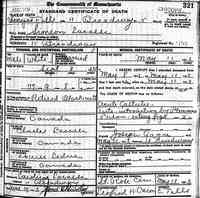
 LACASSE - Death)
Death
Official Death Certificate
Record added: 11/15/2009 6:12:19 PM
Last updated: 9/21/2019 12:19:21 PM
Explore Simon (Simeon) LACASSE's Family & History
View charts and other tools for this ancestor and family.
Explore Simon (Simeon) LACASSE's Birthplace
Explore the birthplace and related genealogy.
Not the ancestor you were looking for?
Search for another person or explore genealogy by place.
Search for a Person by Name
Enter as much of the name as you know.
Search by Place
Continue Researching Simon Lacasse
Search other genealogy websites using this ancestor's known name, dates, and places.
Sign in to open targeted searches for this ancestor on Find a Grave, FamilySearch, and other collections.
New to GreenerPasture? Joining is free.Gifts & Resources Related to Québec, Québec, Canada
Explore local-history books, genealogy resources, and gifts connected with this ancestor's birthplace and family-history research.
Genealogy Gifts from Our Shop
Browse a few family-history favorites, or visit the shop to see the full collection.
 Grandma's Memories Hardcover Journal
 Genealogy Humor Coffee Mug
 Ask Me About My Ancestors Luggage Tag
 Genealogy Definition Car Magnet


Questions, Corrections & New Information
Ask a question or share a correction, source, or new detail about Simon (Simeon) LACASSE.
When possible, include names, dates, places, and sources so the information is easier to verify.