Birth
'It was at Chatillon-en-Bazois that Paul Benoit was born about 1626. Le Bazois, a tiny region of France, occupied the easter part of the French province of Nivernais... Paul brought the surname of Nivernois to New France and it was replaced by that of Livernois.'
Thomas J. Laforest
Our French-Canadian Ancestors : Volume XVI, Page 47
New France
'...He signed a commitment for 5 years in the presence of the notary Lafousse, at Lafleche, on 23 March 1653. Because he was a carpenter, he was promised 100 livres as an annual salary. On 20 June, at the port of Saint-Nazairre, in the presence of the notary Belliote, he obtained a salary advance of 123 livres. That same day he boarded the ship Saint-Nicolas. The son of Francois Benot and of Dimanche Chappelain looked for the last time at the shores of his country...'
'Could the good ship Saint-Nicolas out of Nantes face the ocean squalls? The fact that the ship was not water-tight, was worm-eaten and rotten, might make a difference... After having traveled 350 leagues at sea, it was necessary to turn back... Only on 20 July did the replacement ship Sainte-Marguerite set sail for the New World... Finally, the contingent reached the port of Quebec on Monday, 22 September 1653.'
Thomas J. Laforest
Our French-Canadian Ancestors : Volume XVI, Page 48
 1658 Marriage / Partner
Paul BENOIT dit LIVERNOIS and Isabelle-Elisabeth GOBINET 16 September 1658, Montréal, Québec, Canada (Sault-au-Récollet) (Côte-St-Michel) (Côte-St-Paul)
He was 32 years old.
 1659 Birth of Child
Elisabeth-Isabelle BENOIT dite LIVERNOIS was born 13 July 1659, Montréal, Québec, Canada (Sault-au-Récollet) (Côte-St-Michel) (Côte-St-Paul)
Paul was 33 years old.
1661 Birth of ChildLaurent BENOIT dit LIVERNOIS was born 2 January 1661, Montréal, Québec, Canada (Sault-au-Récollet) (Côte-St-Michel) (Côte-St-Paul)
Paul was 34 years old.
1662 Birth of ChildÉtienne BENOIT dit LIVERNOIS was born 25 December 1662, Montréal, Québec, Canada (Sault-au-Récollet) (Côte-St-Michel) (Côte-St-Paul)
Paul was 36 years old.
1665 Birth of ChildBarbe BENOIT was born 9 May 1665, Montréal, Québec, Canada (Sault-au-Récollet) (Côte-St-Michel) (Côte-St-Paul)
Paul was 39 years old.
1665 Birth of ChildMarie-Anne BENOIT dite LIVERNOIS was born 9 May 1665, Montréal, Québec, Canada (Sault-au-Récollet) (Côte-St-Michel) (Côte-St-Paul)
Paul was 39 years old.
1666 Montreal
Paul Benoist - 40 charpentier habitant
Isabel gabinet - 24 sa femme
Isabelle benoist - 7 fille
Laurens Benoist - 5 fils
Estienne Benoist - 6 fils
Barbe et Marie benoist - 9 mois filles jumelles
1667 Birth of ChildHelene BENOIT was born 17 September 1667, Montréal, Québec, Canada (Sault-au-Récollet) (Côte-St-Michel) (Côte-St-Paul)
Paul was 41 years old.
1669 Birth of ChildMarguerite BENOIT was born 27 December 1669, Montréal, Québec, Canada (Sault-au-Récollet) (Côte-St-Michel) (Côte-St-Paul)
Paul was 43 years old.
1672 Marriage of ChildElisabeth-Isabelle BENOIT dite LIVERNOIS married 22 February 1672, Montréal, Canada, New France to François BLEAU (BLOT)
1672 Birth of ChildGeneviève BENOIT was born 26 May 1672, Montréal, Québec, Canada (Sault-au-Récollet) (Côte-St-Michel) (Côte-St-Paul)
Paul was 46 years old.
1674 Birth of ChildJacques BENOIT was born 4 June 1674 , Montréal, Québec, Canada (Sault-au-Récollet) (Côte-St-Michel) (Côte-St-Paul)
Paul was 48 years old.
1676 Birth of ChildFrançois BENOIT dit LIVERNOIS was born 9 August 1676, Longueuil, Québec, Canada (Saint-Antoine-de-Longueuil)
Paul was 50 years old.
1679 Marriage of ChildBarbe BENOIT married 07 February 1679, Boucherville, Canada, New France to Thomas HÉBERT
1679 Birth of ChildYves BENOIT was born 19 July 1679, Longueuil, Québec, Canada (Saint-Antoine-de-Longueuil)
Paul was 53 years old.
1680 Marriage of ChildMarie-Anne BENOIT dite LIVERNOIS married 27 February 1680, Boucherville, Canada, New France to Jean BOURBON
1681 Longueuil
Paul Benoist, (4) 60 ans; Elizabeth Gobinet, sa femme, 42 ans; enfants: Laurent, 21 ans; Helene, 14 ans; Marguerite, 12 ans; Genevieve, 10 ans; Etienne, 9 ans; Jacques, 8 ans; Francois, 5 ans; Ives, 2 ans; 5 betes a cornes, 12 arepents en valeur.
Title Histoire de Longueuil et de la famille de Longueuil
Authors Alex Jodoin, J. L. Vincent
Publisher Impr. Gebhardt-Berthiaume, 1889
Original from the New York Public Library
Digitized Dec 18, 2007
Length 681 pages
Page 65
 1685 Death of Child
Elisabeth-Isabelle BENOIT dite LIVERNOIS died 5 November 1685 , Montréal, Québec, Canada (Sault-au-Récollet) (Côte-St-Michel) (Côte-St-Paul)
Paul was 59 years old.
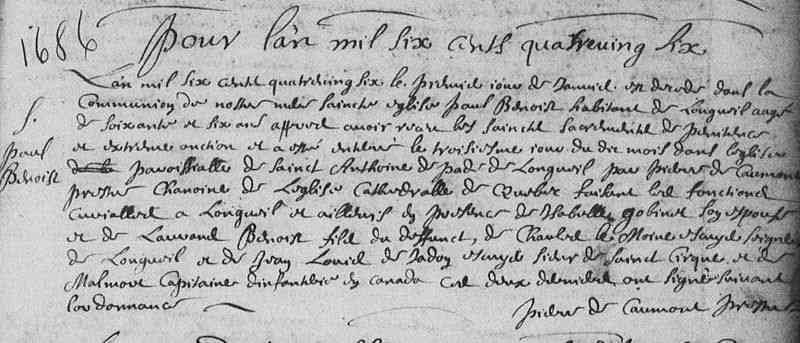
1686 Death
Death found at Saint-Famille-de-Boucherville, Boucherville, QC, Canada in Drouin Collection.
Paul Benoist
'Paul Benoit died on the first of January 1686. The parish of Longueuil was not yet organized, so it was at Boucherville, on Thursday, 3 January, that he was buried in the presence of his eldest son Laurent, Seigneur Charles Lemoyne and Jean-Louis Jadon, Sieur de Saint-Cirque, a captain in the army. The curate Pierre de Caumont presided at the funeral ceremony. Paul was 66 years old, according to the registry.'
Thomas J. Laforest
Our French-Canadian Ancestors : Volume XVI, Page 54
Death
Name: Paul Benoist
Gender: Male
burial date: 03 Jan 1686
burial Place: St. Antoine De Longueuil, Chambly, Quebec
Death Date: 01 Jan 1686
death Place: St. Antoine De Longueuil
Age: 66
Birth Date: 1620
birthPlace:
Occupation:
Race: White
Marital Status: Married
spouse's Name: Isabelle Gobinet
father's Name:
father's birthPlace:
mother's Name:
mother's birthPlace:
indexing project (batch) number: B03669-9
system origin: Canada-EASy
source Film Number: 1031703
reference number: P-31 S-1
'Canada Deaths and Burials, 1664-1955,' index, FamilySearch (familysearch.org/ pal:/ MM9.1.1/ F2PP-VJ3 : accessed 04 Jan 2013), Paul Benoist, 01 Jan 1686; citing reference P-31 S-1, FHL microfilm 1031703.


 Québec Généalogie - The Seigneurial System (1627 - 1854)
 Habitants played an essential role in creating a permanent, settled population along the St. Lawrence River. But it was not an easy life...

 See marriage record for Paul BENOIT dit LIVERNOIS and Isabelle-Elisabeth GOBINET




Questions, Corrections & New Information
Ask a question or share a correction, source, or new detail about Paul BENOIT dit LIVERNOIS.
When possible, include names, dates, places, and sources so the information is easier to verify.