
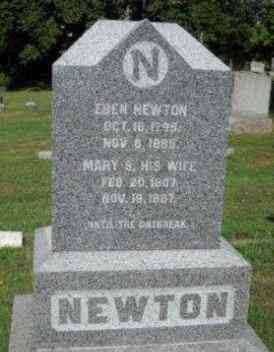
Eben NEWTON
Biography
" Eben Newton, lawyer, born at Goshen, Connecticut, October 16th, 1795, was the son of Isaac Newton, a farmer at Goshen. In his early years he worked on the farm and attended the schools of the neighborhood. In 1814 he removed to Portage county, Ohio, and devoted himself for the next four years to farming. In 1818, he commenced the study of law at Ravenna. He returned to Connecticut in 1822, and continued his studies there, but soon returned to Ohio, and in August, 1823, was admitted to practice in Trumbull county. He was immediately taken into partnership with the Hon. Elisha Whittlesey and the association thus formed continued for twenty years, whilst their friendship lasted through life. For three-fourths of the time the association continued, his partner was a member of Congress, and the whole conduct and management of the law business mainly rested on himself. In 1842 he was elected to the State senate by Whig votes. Whilst in the senate he was elected president judge of the third judicial district, and filled that position with marked ability. In 1850 he was elected representative to Congress for the term from 1851 to 1853. Returning from Congress he resumed the practice of his profession, and took but little active part in political life until, in 1862, he was again elected to the State senate, being the nominee of the Republican party. After leaving the State senate, in 1865, he was called on to manage the Jennings estate, a difficult and laborious task that occupied him for the next ten years. The property at the time of the death of Mr. Jennings, amounted to two millions, invested in real estate in many States of the Union. Mr. Jennings kept no books or systematized accounts, and the affairs of the estate were involved in seemingly inextricable confusion. The original executors resigned the hopeless task, and he was appointed administrator. The management and settling up of this vast and intricate estate gained for him a high reputation as a shrewd and able lawyer and businessman, of the strictest integrity and honor. He enhanced the value of the property to the relatives, and protected it successfully against many attempted frauds. This case, which became widely known, and was conducted while he was between seventy and eighty years of age, the most active and laborious period of his life. During his long legal practice he had twenty-seven students, more than half of whom became honorably prominent as public men, in Congress or in the legislature, and others were numbered among the foremost members of the Ohio bar. Although at an advanced age at the breaking out of the Rebellion, he became active in the Union cause at home, working to fill the quota of troops by raising money and men. He took a strong interest in the construction of local railroads and plank roads, and was president and one of the most efficient supporters of the Ashtabula and New Lisbon Railroad. He was very liberal to the poor, and gave freely to the support of churches, schools, and colleges. His religious connection was with the Presbyterian church, of which he was a valuable member. Throughout his life he took a strong interest in agriculture, had large farms in various parts of the United States, raised thorough-bred stock, and was extensively known as a stock-breeder and agriculturist. He was a very interesting and able speaker; his speeches in the State senate and in Congress were widely circulated and read. His published eulogy on the life and services of Governor Tod attracted much attention, it being, like his speeches generally, noticeable for clear diction, strong Saxon language, and pure and simple style. He twice visited Europe, once in the interest of the Jennings estate, and once on other business, and on his return after each trip delivered lectures of much merit on the manners and customs of European society, as compared with American, and to the credit of the latter. In 1874, at the age of seventy-nine, he was traveling alone in Italy. For the ten years previous to that date he had been obliged to write with his left hand, the right having been disabled by continuous work. At eighty-three he was hale, hearty, and clear-headed and possessed the esteem of all who knew him. He married in May, 1826, Miss Mary Church, of Canfield, grand-daughter of Nathaniel Church, one of the original proprietors of the extensive tract of land known as the Western Reserve of Ohio, and had one son and three daughters."
Source: Reports ... Proceedings of the Annual Meeting of the Association ....
By Ohio State Bar Association Meeting, Ohio State Bar Association, Meeting
Published by Laning Printing Co., 1887
Item notes: vol. 7
Original from Princeton University
Digitized Apr 21, 2008
Page 69

Learn more about the life of

 Eben NEWTON.
Visit Goshen, Connecticut, USA
Discover the people who lived there, the places they visited and the stories they shared.