
HISTORICAL IMAGE
Winslow, Maine, USA
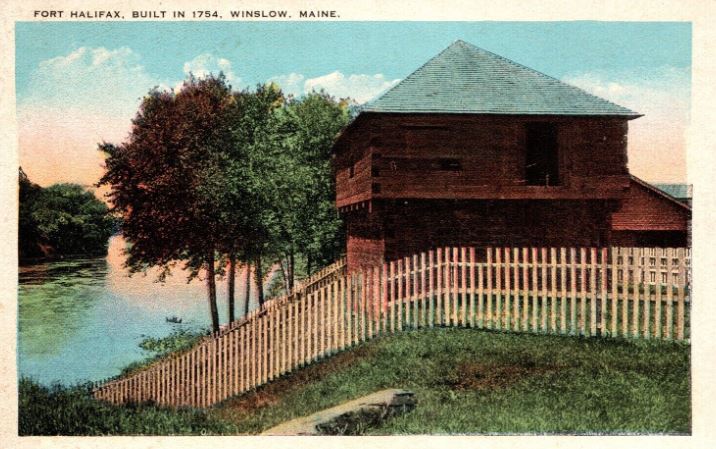
Fort Halifax, Built in 1754, Winslow, Maine
Fort Halifax is a historic site located in Winslow, Maine, USA. It is one of the oldest surviving wooden blockhouses in North America and has significant historical and cultural importance.
Fort Halifax was constructed in 1754 during the French and Indian War (also known as the Seven Years' War) by order of the Massachusetts Bay Colony's government. The fort was built to provide protection to settlers in the region and to establish a military presence on the Kennebec River, which was an important transportation route at the time.
The fort was a wooden blockhouse-style structure surrounded by a stockade wall. It had two stories and was equipped with gun ports to allow defenders to fire upon attackers from within the safety of the fort. The overall design was typical of the defensive structures built during that era.
Fort Halifax served as a key defensive point on the Kennebec River, which was a major travel and trade route connecting the interior of Maine with the coast. It played a role in both military operations and in supporting settlers as they moved into the area.
The fort saw limited military action during its existence, but as tensions decreased after the French and Indian War, it gradually lost its strategic importance. By the American Revolution, it was no longer in active use. Over time, the fort fell into disrepair.
In the 20th century, efforts were made to preserve the historic site. In 1927, the DAR acquired the site and initiated restoration efforts.
 by order of the Massachusetts Bay Colony's government. The fort was built to provide protection to settlers in the region and to establish a military presence on the Kennebec River, which was an important transportation route at the time.
The fort was a wooden blockhouse-style structure surrounded by a stockade wall. It had two stories and was equipped with gun ports to allow defenders to fire upon attackers from within the safety of the fort. The overall design was typical of the defensive structures built during that era.
Fort Halifax served as a key defensive point on the Kennebec River, which was a major travel and trade route connecting the interior of Maine with the coast. It played a role in both military operations and in supporting settlers as they moved into the area.
The fort saw limited military action during its existence, but as tensions decreased after the French and Indian War, it gradually lost its strategic importance. By the American Revolution, it was no longer in active use. Over time, the fort fell into disrepair.
In the 20th century, efforts were made to preserve the historic site. In 1927, the DAR acquired the site and initiated restoration efforts.
)