


Am I Your Ancestor?
SHEPARD Family Tree – Connecting the Past to the Present!
Samuel Stent SHEPARD was born 3 January 1838
Samuel Stent SHEPARD was the child of ? and ?Samuel Stent was a soldier in the U.S. Civil War.
Tracing Ancestors Through Military Service Records: Unveiling Family Heroes
Samuel Stent SHEPARD died 14 June 1869 in Branford, Connecticut, USA.
Company A, 10th Regiment, Connecticut Volunteers
Details of the family tree of Samuel appear below.


U.S. CIVIL WAR - My Ancestor Fought in the Civil War - Ceramic Coffee Mug
Sip your favorite brew from this inspiring mug that pays tribute to your ancestor's bravery. This mug features images of actual Civil War soldiers. The caption, 'My Ancestor Fought in the Civil War. That explains my appreciation for freedom,' is a powerful reminder of the sacrifices made for the freedoms we enjoy today.

Civil War Stories Live in My Family History! Bookmark
Whether you’re diving into historical novels or piecing together your family tree, this bookmark will keep your place in history. A thoughtful gift for history lovers and proud descendants of Civil War ancestors!
Occupation
Samuel Stent SHEPARD was a blacksmith.
A forgeron, or blacksmith, was primarily a craftsman of wrought iron on the anvil. Protecting himself with a thick leather apron, he used a bellows (first made of leather, then wood and finally metal) to push the air that fuelled the coal fire of the forge, a type of cast iron table where the iron was reddened... Using pliers of various sizes to hold the hot iron, the blacksmith would then give it a specific shape with the help of different hammers. The blacksmith made farm instruments, vehicle accessories and even schooners, cemetery crosses, steel bandages, hooks for hay bales, etc.
Source: tfcq.ca
Source: Old Sturbridge Village, Sturbridge, Massachusetts
Samuel Stent SHEPARD was a blacksmith.
A forgeron, or blacksmith, was primarily a craftsman of wrought iron on the anvil. Protecting himself with a thick leather apron, he used a bellows (first made of leather, then wood and finally metal) to push the air that fuelled the coal fire of the forge, a type of cast iron table where the iron was reddened... Using pliers of various sizes to hold the hot iron, the blacksmith would then give it a specific shape with the help of different hammers. The blacksmith made farm instruments, vehicle accessories and even schooners, cemetery crosses, steel bandages, hooks for hay bales, etc.
Source: tfcq.ca
Source: Old Sturbridge Village, Sturbridge, Massachusetts
 Share the History, Life Events, and Stories of Samuel Stent SHEPARD
(Add details like birth, baptism, census records, military service, obituary, personal achievements, and more.)
[Hide/Show]
Discovering the Ancestry of Samuel Stent SHEPARD: Events, Photos & Historical Records
 1843 - The Christmas card is invented (Sir Henry Cole and John Callcott Horsley, England)
Artificial Freezer Patented (Nancy M. Johnson, Philadelphia, Pennsylvania, USA)
1845 - The rubber band is invented (Stephen Perry, England)The refrigerator is invented (John Gorrie, United States)
1868 - The typewriter is invented (Christopher Latham Sholes, United States)Thomas Edison applies for his first patent, the electric vote recorder.
Death
Name: Samuel Stent Shepard
Gender: Male
Burial Date:
Burial Place:
Death Date: 14 Jun 1869
Death Place: Branford, New Haven, Connecticut
Age: 31
Birth Date: 1838
Birth Place:
Occupation:
Race:
Marital Status:
Spouse's Name:
Father's Name:
Father's Birthplace:
Mother's Name:
Mother's Birthplace:
Indexing Project (Batch) Number: B03419-0
System Origin: Connecticut-EASy
GS Film number: 3200
Reference ID:
'Connecticut Deaths and Burials, 1772-1934,' database, FamilySearch (familysearch.org/ ark:/ 61903/ 1:1:F765-VY6 : 3 December 2014), Samuel Stent Shepard, 14 Jun 1869; citing Branford, New Haven, Connecticut, reference ; FHL microfilm 3,200.'
familysearch.org (Mormon Genealogy Records)
Unofficial Guide to FamilySearch.org: How to Find Your Family History on the World's Largest Free Genealogy Website
Name: Samuel Stent Shepard
Gender: Male
Burial Date:
Burial Place:
Death Date: 14 Jun 1869
Death Place: Branford, New Haven, Connecticut
Age: 31
Birth Date: 1838
Birth Place:
Occupation:
Race:
Marital Status:
Spouse's Name:
Father's Name:
Father's Birthplace:
Mother's Name:
Mother's Birthplace:
Indexing Project (Batch) Number: B03419-0
System Origin: Connecticut-EASy
GS Film number: 3200
Reference ID:
'Connecticut Deaths and Burials, 1772-1934,' database, FamilySearch (familysearch.org/ ark:/ 61903/ 1:1:F765-VY6 : 3 December 2014), Samuel Stent Shepard, 14 Jun 1869; citing Branford, New Haven, Connecticut, reference ; FHL microfilm 3,200.'
familysearch.org (Mormon Genealogy Records)
Unofficial Guide to FamilySearch.org: How to Find Your Family History on the World's Largest Free Genealogy Website
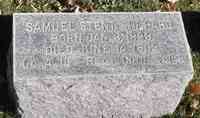

Samuel is buried at: Branford Center Cemetery Branford, New Haven County, Connecticut, USA
Added: 4/26/2017 5:00:24 PM
- Updated: 3/16/2018 1:50:13 PM

Not the person you are looking for? Try again!
Search for YOUR Family by Name
NOTE: If you don't know your ancestor's whole name or are unsure of the spelling, specify part of the name.Search for YOUR Family by Place
Genealogy research for Samuel Shepard (on other sites)

Find out more about Samuel Stent SHEPARD.
Sign In or
Join for FREE! to see the details!
Completely FREE. We will never ask for your credit card or personal information.